

All the deployments are automated and Ansible performs a central part. With the developing complexity of the code base, a new method was necessary to get over the Ansible restrictions which will allow us to tackle new issues.
TDP is an 100% open up supply massive details system based on the Hadoop ecosystem. Alliage gives aid and skilled providers on TDP.
Ansible constraints
Scheduling in Ansible is not easy. Obtaining a job activated at the finish of a different (thanks to handlers) or deciding upon the diverse jobs to be executed in accordance to the will need (many thanks to tags) does not scale.
In TDP, the key way to control the deployment is by means of variables. Defining and versioning variables in Ansible is an easy way to complicate your existence, there is at this time 22 diverse locations where by you can outline variables and as the task grows in complexity, it is hard to preserve track of in which each individual variable is described or re-described. Also it can in some cases lead to defining defaults exterior our manage. We decided to incorporate a 23rd way to quickly edition, and add custom made behavior. We had to build the required tools to effectively edition these variables.
TDP Lib
The reply to these two demands is tdp-lib. This SDK makes it possible for appropriate collections to define a DAG (directed acyclic graph) that contains all the relationships concerning factors and expert services, detailing the execution order of the duties. In addition, it lets the definition of variables for every provider and for each element in yaml information.
Based mostly on these two attributes, tdp-lib is in a position to restart the minimum variety of components of the TDP stack to use configuration changes.
N.B: tdp-lib does not change ansible, it uses ansible internally to deploy TDP
TDP Roadmap
The TDP ecosystem is transferring ahead, and developping a set of software to help control cluster deployment.
- tdp-lib: job which part is to employ core characteristics such as variable versioning and deployment with ansible, status: Key functions executed
- tdp-server: Rest Api working with tdp-lib to deploy the managed cluster, position: Key attributes carried out
- tdp-ui: Website interface to give prime notch person working experience to people, position: In active development
- tdp-cli: shopper in command line interface to interact with tdp-server, position: Not still begun
TDP Definitions
Operations
A terminology has been described to be ready to exactly outline what TDP can and cannot do. The foundation strategy of TDP is an operation. There are two forms of functions, the support procedure and the ingredient functions. A provider procedure is designed of two areas: the services title, and the action name (support_motion). Services functions are typically meta operations (translating into noops), meant to plan element procedure within the assistance. Then, there are the component operations. They are composed of a few components: the services name (ie. ZooKeeper), the part name (ie. Server), and the action identify (ie. put in). Illustration: zookeeper_server_install.
Study far more about operations
DAG definition
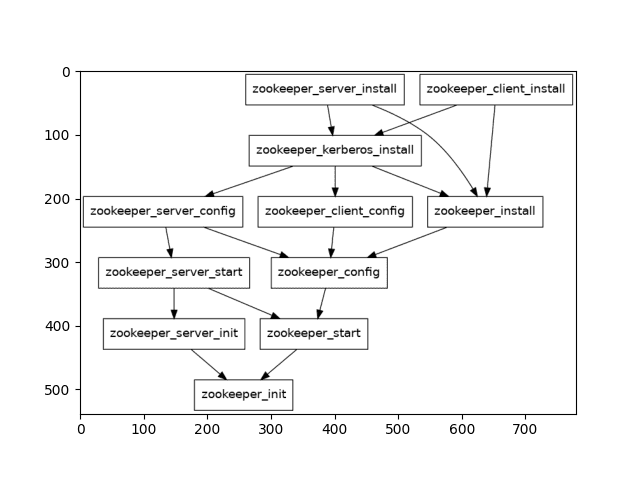
The DAG is outlined working with YAML documents found within the folder tdp_lib_dag of a assortment (defined later on). Each file is a list of dict containing the keys: name, noop (optional), and is dependent_on. It is attainable to use only one particular file to outline every dag nodes, but as a conference, we individual them.
Present-day point out:
tdp_lib_dag/
├── exporter.yml
├── hadoop.yml
├── hbase.yml
├── hdfs.yml
├── hive.yml
├── knox.yml
├── ranger.yml
├── spark3.yml
├── spark.yml
├── yarn.yml
└── zookeeper.yml
Sample of a company definition:
---
- title: zookeeper_server_set up
  relies upon_on: []

- title: zookeeper_set up
  noop: certainly
  relies upon_on:
    - zookeeper_server_set up
    - zookeeper_consumer_put in
    - zookeeper_kerberos_put in
Here’s an example of a dag made up of only the zookeeper nodes:
TDP Vars
As stated before, working with variables in ansible is tricky. In the early TDP variations, we were being making use of defaults variables inside of the collections’ roles that had to be overridden employing Ansible’s team variables. Using this approch intended we could not potentially handle all the values from outdoors a collection, that means getting a hard time versioning and offer control to outside instruments. This is exactly where the TDP Vars arrive in. We resolved to produce a particular position wherever we could outline and deal with variables. This area does not exist when cloning the collections from github. This is a action you want to perform at set up time. The most widespread way to do it when you are not making use of the library is to duplicate the variables from collection_path/tdp_vars_defaults into your stock (inventory/tdp_vars). Utilizing the library, there are initialization functions permitting you to conduct this important step.
In the folder tdp_vars, the folder names do not make any difference, only the variable information do. The variable loading in Ansible is done in two measures. Very first, at Ansible initialization time, the variable are loaded by an stock plugin: tosit.tdp.stock. This plugin loads each individual YAML file in the tree stock/tdp_vars and puts them in the group vars all as keys with a prefix. Vital, variable are not settled at this phase, if you search at their information, you will see the jinja templates. For case in point, the file stock/tdp_vars/hadoop/hadoop.yml will be loaded as "TDP_Automobile_hadoop": ...values. Then, come the managing time, the place playbooks need to use the plugin solve, that will merge and then solve the variables. The solve plugin normally takes an argument which is the company + component name which is utilized to generate variable inheritance.
Illustration: Defining the variables files hdfs and hdfs_namenode will load hdfs initially, and then override it with the values from hdfs_namenode. Be aware that this applies only when the argument to the resolve plugin is hdfs_namenode. Working with the argument hdfs_datanode will override the hdfs variables with values from hdfs_datanode.
The precedence policies described in this posting nonetheless applies. The tdp vars can be deemed to be at the position defaults degree. And consequently, can be overriden by team vars or host vars.
N.B: An inventory plugin is utilised rather of a vars plugin mainly because you simply cannot use vars plugin from a collection in Ansible 2.9.
Collections
A collection is an entity made up of a few folders: tdp_lib_dag, tdp_vars_defaults, and playbooks. The playbooks folder incorporates all the operations available in the selection, they really don’t have to be a portion of the DAG. Operations exterior of the dag are identified as particular actions.
Several collections can be utilised at the exact time by tdp-lib by furnishing a list of collections. There are specific principles and behaviors defined as adhere to:
- You can determine dependencies in the DAG from an additional collection, but the other collection will become needed
- tdp-assortment, is thought of the main collection, and thus, simply cannot rely on a further collection
- The get the selection is supplied is applied to override operations and variables. If you give the collections in the purchase
[collection_a, collection_b]and they both of those define the playbookzookeeper_init, the library will use the playbook fromcollection_b. For variables, the library will merge (at initialization time only) the variables fromcollection_aandcollection_b, employingselection_bas override. (Helpful to includeauth_to_communityguidelines globally for illustration)
TDP-lib is an crucial action towards running a TDP cluster, it is not meant to be made use of right by end users, but holds the main characteristics of what is required to manage a TDP cluster.
TDP ecosystem is relocating quick, and a lot of options are implemented on the day-to-working day, do not be reluctant to participate, contributions are welcome!


